
Every metal part in an engine, a gearbox or a pump started life as a shape someone had to create. Casting is the oldest and still the most economical way to create that shape: melt the metal, pour it into a cavity, let it solidify, and the part comes out close to its final form. For a sourcing engineer, the question is rarely whether to cast a part. It is which casting process to cast it by — because that single decision drives your tolerance, your surface finish, your tooling bill and your cost per piece for the life of the component.
This guide explains what casting is, walks through the main types of casting processes, and then goes deep on the two routes most buyers of iron and steel parts end up choosing between: shell mould casting and green sand casting. You will find the tolerance grades each route actually holds, the volumes at which each one pays for itself, and a decision framework you can apply to your own drawing.
What Is Casting?
Casting is a manufacturing process in which molten metal is poured into a mould cavity shaped like the finished part, allowed to solidify, and then removed. First you make a pattern. You form a cavity around that pattern. You pour hot metal into the cavity. When the metal cools and hardens, you break out or open the mould and the casting is inside.
Four terms come up in every casting discussion, whatever the process:
- Pattern — the model of the part. Its shape is transferred into the moulding material to create the cavity. Patterns are made in wood, resin or metal depending on how many parts you need.
- Mould (or form) — the hollow cavity the molten metal fills.
- Core — a sand or ceramic insert placed inside the mould to create internal passages, bores and holes that the pattern cannot form on its own.
- Flask — the box that holds the mould. In sand casting it comes in two halves: the cope (top) and the drag (bottom).
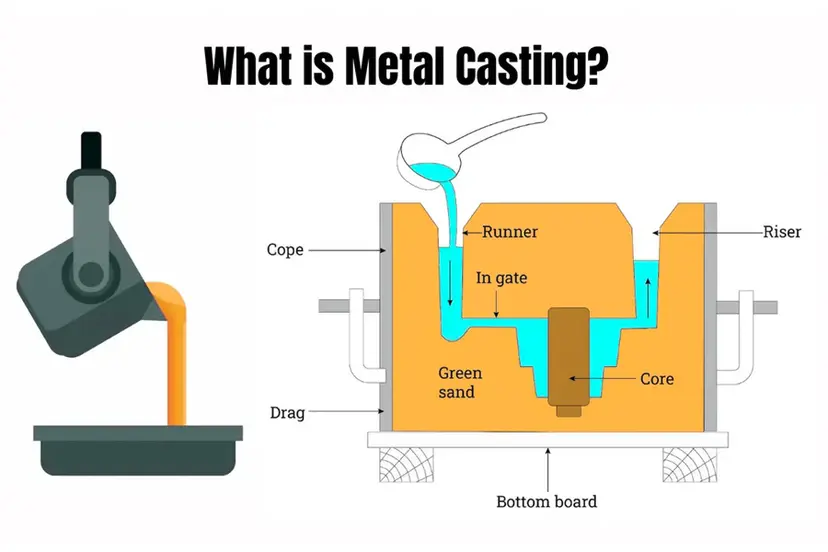
Why B2B buyers specify castings instead of machining from solid
Casting earns its place on three grounds that matter to a procurement or design engineer:
- Material cost. A cast part starts close to net shape. Machining the same geometry from bar or plate turns most of the material into swarf.
- Geometry you cannot machine. Internal water jackets, curved passages, varying wall sections and integrated bosses come out of a mould in one piece.
- Cost per piece at volume. Once tooling exists, the marginal cost of the next casting is low. Fabrication and machining costs stay roughly flat per part however many you order.
The trade-off is dimensional. A casting leaves the mould to a casting tolerance, not a machining tolerance, and critical faces are finished afterwards. Getting that split right — what the foundry holds as-cast and what gets machined — is most of the engineering conversation.
Types of Casting Processes
Casting is a family of processes, not one process. They all share the pattern-mould-pour- solidify logic; what separates them is how the mould is made and whether it survives the pour.
- Green sand casting — moulds of damp silica sand bonded with clay. The lowest-cost route and the workhorse for iron.
- Shell mould casting — thin, cured shells of resin-coated sand formed on a heated metal pattern. Tighter tolerance and better finish than green sand.
- Furan and no-bake resin sand casting — chemically bonded sand moulds for large or low-volume work where green sand cannot hold the shape.
- Lost foam casting — a polystyrene pattern vaporised by the incoming metal, allowing complex one-piece geometry with no parting line.
- Investment casting (lost wax) — wax patterns coated in ceramic. The best surface finish and thinnest walls of the expendable-mould processes.
- Die casting — molten alloy injected under pressure into a steel die. Very high volumes, non-ferrous alloys, high tooling cost.
- Permanent mould / gravity die casting — reusable metal moulds filled by gravity. Finer grain structure than sand for aluminium and copper alloys.
- Centrifugal casting — metal poured into a spinning mould. Produces dense, inclusion-free cylindrical parts such as cylinder liners, bushes and sleeves.
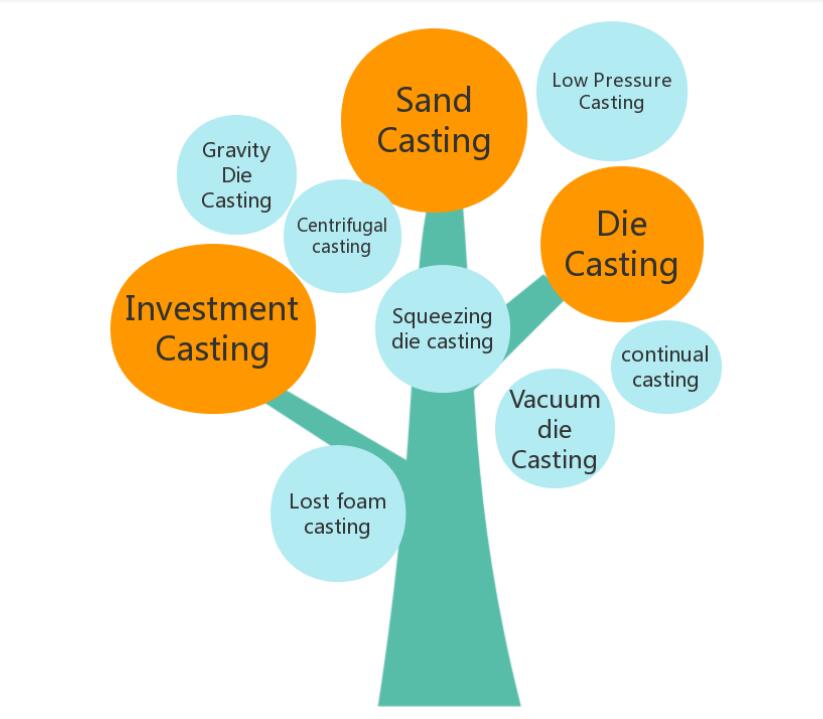
Casting process comparison at a glance
The figures below are typical achievable ranges for iron and steel castings. Treat them as a starting point for a conversation with your foundry, not as a specification — every one of them moves with part size, section thickness, sand system and moulding equipment.
| Process | Typical tolerance grade (ISO 8062) | As-cast surface Ra | Practical part weight | Tooling cost | Economic volume |
|---|---|---|---|---|---|
| Green sand — hand moulded | CT9–CT11 | Coarse | Grams to several tonnes | Lowest (wood or resin patterns) | 1 to a few hundred |
| Green sand — machine / high pressure | CT8–CT10 | Moderate | 0.5 kg to ~300 kg+ | Low to moderate (match plates) | Hundreds to very high |
| Shell mould casting | CT6–CT8 | Fine | Up to roughly 20–30 kg | Higher (machined metal patterns) | Hundreds to tens of thousands |
| Investment casting | CT4–CT6 | Finest of the expendable moulds | Grams to ~50 kg | High (wax dies) | Hundreds to high |
| Centrifugal casting | Dense, near-net cylindrical | Machined bore and OD | Liners, sleeves, bushes, rings | Moderate (dies reusable) | Low to very high |
Every type of casting uses the same underlying ideas. What changes is how the mould is made — and that is what sets the tolerance, the finish and the price.
Shell Moulding vs Green Sand Casting
For grey iron, ductile SG iron and steel parts in the sub-30 kg range, shell moulding and green sand are the two processes that most quotations come down to. The rest of this guide compares them properly: how each one works, what each one holds, and when each one is the right commercial answer.
What Is Shell Mould Casting?
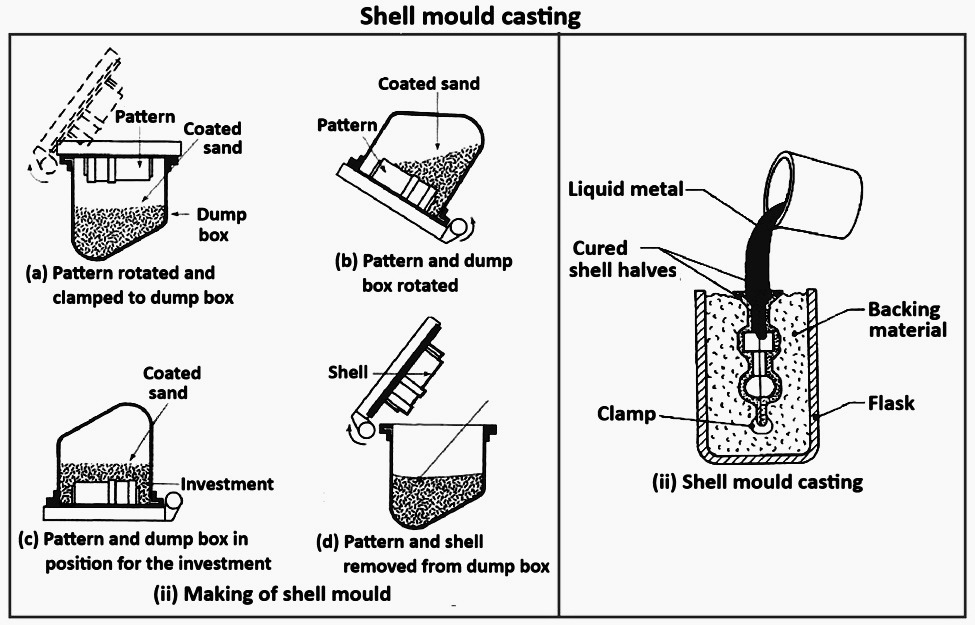
Shell mould casting — also written shell moulding or shell molding — forms the mould from silica sand whose grains are pre-coated with a thermosetting resin binder. A metal pattern is heated, the resin-coated sand is brought into contact with it, and the heat cures a thin, rigid shell around the pattern profile. That shell — usually 6 to 15 mm thick — is the mould.
Because the pattern is machined metal rather than rammed sand, the cavity reproduces the drawing far more faithfully than a sand mould can, and it reproduces it identically on the thousandth shell as on the first.
When shell moulding is the right call
- You need an as-cast surface good enough to ship or paint without extensive fettling.
- You need dimensional control tight enough to cut machining operations out of the route.
- Your part is small to medium and carries detail — thin sections, cored passages, cast-in lettering or logos.
- Your annual volume is high enough to amortise a machined metal pattern.
How shell mould casting works, step by step
- Heat the metal pattern. The pattern is brought to roughly 175–260 °C on a heated plate or in an oven.
- Invest in resin-coated sand. The hot pattern is inverted over a dump box of resin-coated sand. Sand contacting the pattern is heated past the resin’s softening point and a layer adheres.
- Cure the shell. The part-cured shell is stripped and returned to the oven briefly so the resin cross-links right through. Cope and drag shells are made the same way.
- Assemble. Cores are set if internal passages are required, the two shell halves are clamped or glued together, and the assembly is placed in a flask supported by backing shot or loose sand.
- Pour. Molten iron, steel or aluminium is poured through the in-gate into the shell cavity.
- Break out and clean. Once solidified, the shell is broken away — it is single-use — and gates, runners and risers are removed before any final fettling.
Note for designers: because the shell is thin and rigid, it behaves more like a die than a sand mould. That is why parts come out of it looking closer to machined than cast.
Advantages and Limitations of Shell Moulding
Advantages
- Tighter dimensional tolerance. Typically ISO 8062 CT6–CT8 on iron castings, against CT8–CT10 for green sand. In practical terms that is around half a millimetre on a medium feature rather than two.
- Better as-cast surface finish. Fine, uniform sand and a rigid shell give a markedly smoother surface than green sand — commonly quoted around Ra 1.6–3.2 µm on a well-controlled line.
- Thinner walls and finer detail. Sections down to roughly 2–3 mm are practical, along with small radii and cast-in identification.
- Less downstream work. Tighter as-cast dimensions and a cleaner surface remove fettling hours and sometimes whole machining operations.
- Repeatability. The metal pattern does not wear or distort the way a rammed sand mould can, so shell 10,000 matches shell 1. This is what makes the process attractive for mass production.
- Smaller draft angles. Draft of roughly 1° is usually sufficient, against 1.5–3° external and 2–5° internal for green sand, which means less material and less machining stock.
Limitations
- Higher tooling and consumable cost. Machined metal patterns, resin-coated sand and curing ovens all cost more than wood patterns and clay-bonded sand.
- Part size ceiling. Practically limited to small and medium castings, commonly quoted up to around 20–30 kg.
- Emissions and extraction. Curing and burning resin produces fume that requires proper extraction and filtration — a real capital and compliance cost for the foundry.
- Sand is harder to reclaim. Resin-bonded sand needs thermal reclamation rather than the simple reconditioning green sand allows.
Where shell moulding is used in practice
- Engine brackets, transmission covers, rocker arms and camshaft components
- Pump bodies, valve bodies and impellers for process industry
- Hydraulic manifolds and housings with cored internal passages
- Any part where the buyer is paying for a machining operation that tighter as-cast tolerance could remove
Our longer write-up on the advantages of shell moulding for complex shapes covers the geometry side in more depth.
What Is Green Sand Casting?
Green sand casting builds the mould from damp, clay-bonded silica sand packed around a pattern. “Green” refers to the moisture, not the colour — the mould is poured in the wet, uncured state.
A typical green sand system runs roughly 75–85% silica sand, around 10% bentonite clay as the bonding agent and 2–5% water by weight, plus additives such as sea coal or cereal binder depending on the alloy and the finish required. The exact balance is set by the foundry’s own sand testing, not by a recipe — and the sand is reconditioned and reused continuously, which is the root of the process’s cost advantage.
Types of Green Sand Moulding Processes
How the sand is compacted matters as much as the sand itself. Mould hardness and density drive the dimensional result, so the moulding method is effectively a tolerance decision.
- Arpa (jolt-squeeze) moulding. A jolt-squeeze machine first vibrates the sand into the pattern, then applies squeeze pressure to compact it further. It suits medium to large castings and short to medium runs, and machine sizes (ARPA 300, 450, 900, 1300) determine box size and part weight. The flexible, cost-effective middle ground for jobbing and batch foundry work.
- High pressure moulding line (HPML). Fully automated lines compact the sand at high speed and high pressure, producing dense, uniform moulds at rates of hundreds of moulds per hour. Mould hardness is consistent, so dimensional accuracy improves sharply — casting tolerances of roughly 1–1.5 mm are achievable on suitable parts. The trade-off is capital-intensive plant and tooling that must be built to suit the line.
- Manual green sand moulding. Moulds rammed by hand with simple tools. Minimal equipment investment and maximum flexibility for prototypes, one-offs, jobbing work and awkward geometry — but density, hardness and repeatability depend heavily on the moulder.
- Jolter (jolt-only) moulding. Compaction by rapid vertical jolting alone. Simpler and cheaper than jolt-squeeze, with moderate mould density. Suited to small and medium castings where moderate compaction is sufficient.
If a supplier quotes green sand without telling you which of these they will run your part on, that is a question worth asking. The gap between hand moulding and a high pressure line is the difference between CT10 and CT8.
When green sand casting is the right call
- The part is large or heavy — hundreds of kilograms is routine, tonnes are possible.
- Tooling spend needs to stay low, or the design is not yet frozen.
- Critical features will be machined anyway, so as-cast tolerance on those faces does not matter.
- Volumes are either very low (jobbing) or very high (an automated line).
How green sand casting works, step by step
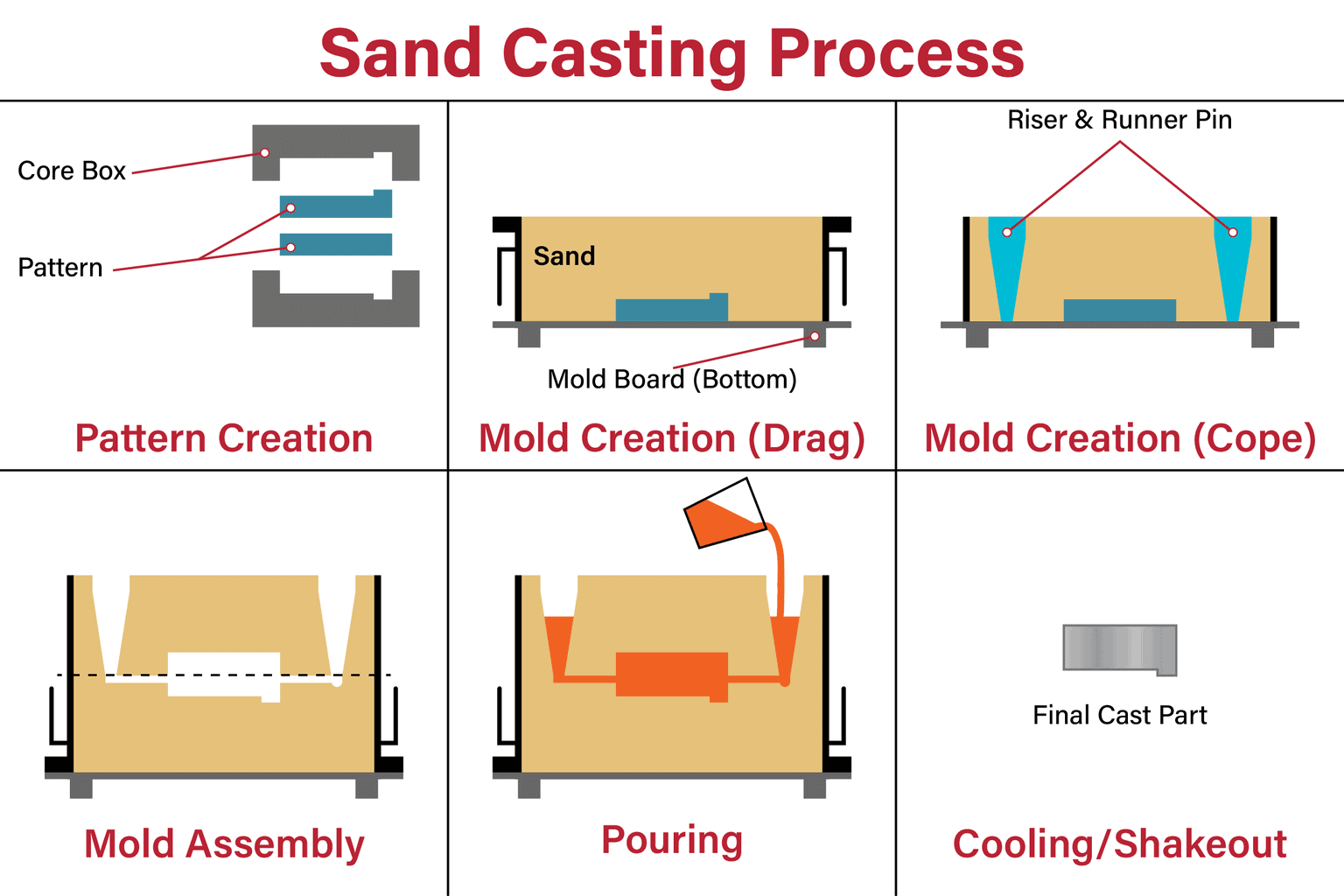
- Set the pattern. The pattern is located on a flat board or match plate.
- Ram the drag. The bottom flask is placed over the pattern, filled with green sand and compacted around the pattern.
- Roll over and strip. The flask is inverted and the board removed, leaving the pattern impression in the sand.
- Ram the cope. The top flask is placed on the drag, sand is rammed around the pattern again, and cores are set where internal passages are required.
- Cut gates and risers. Sprue, runners, in-gates and risers are formed so metal fills cleanly and gases can escape.
- Close and pour. Cope and drag are clamped together and molten metal is poured through the sprue.
- Cool and shake out. Once solidified, the mould is broken open, the sand is returned to the system, and gates, risers and flash are removed at fettling.
Process control note: moisture in green sand is a live variable, not a setting. Too wet and steam generates gas porosity and blows; too dry and the mould crumbles and the sand will not hold an edge. Sand testing is a daily routine in any foundry that takes its dimensional results seriously.
Advantages and Limitations of Green Sand Casting
Advantages
- Lowest mould cost of any process. Silica sand, bentonite clay and water, with no resin and no curing ovens.
- Effectively no size ceiling. Machine bases, housings, engine blocks and frames weighing hundreds of kilograms are routine work.
- Sand is reclaimed and reused. After shakeout the sand is cooled, screened and reconditioned back into the system, which keeps both cost and waste down.
- Cheaper, faster tooling. Wood or resin patterns can be made quickly and modified during sampling without the cost of re-machining metal tooling.
- Scales in both directions. The same process serves a single prototype casting and an automated line running hundreds of moulds an hour.
Limitations
- Wider as-cast tolerance. Typically ISO 8062 CT8–CT10 depending on the moulding method, so critical features need machining stock.
- Rougher as-cast surface. The sand grain is visible on the casting. Where finish matters, plan for shot blasting, grinding or machining.
- Limits on thin sections and fine detail. Minimum practical wall thickness is around 4–6 mm in grey iron and 5–7 mm in ductile iron; coarse sand will not reproduce small radii or crisp lettering.
- Larger draft angles. Around 1.5–3° on external surfaces and 2–5° internally, which adds material and machining stock.
- More manual content. On non-automated lines, ramming, gating and fettling are labour-intensive, and consistency follows the operator.
Where green sand casting is used in practice
- Engine blocks, cylinder heads and housings for automotive and agricultural machinery
- Machine bases, frames, gearbox casings and counterweights
- Valve bodies, pump housings and general iron parts for process plant
- Any large or heavy casting where the finished dimensions come from machining, not the mould
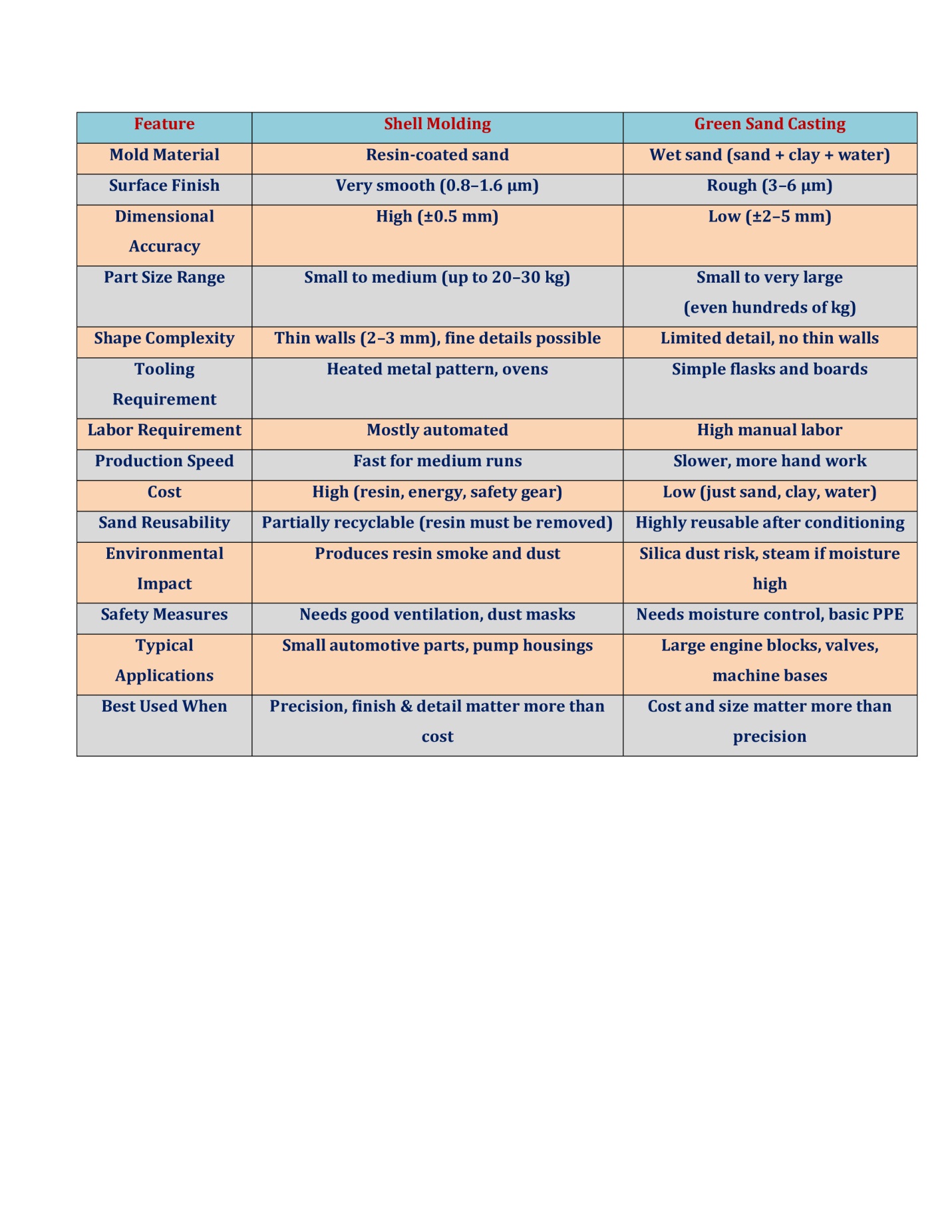
Shell Moulding vs Green Sand Casting: Side-by-Side Comparison
| Criterion | Shell mould casting | Green sand casting |
|---|---|---|
| Mould material | Resin-coated silica sand, thermally cured | Silica sand bonded with clay and water |
| Pattern | Machined metal, heated in service | Wood, resin or metal, at ambient temperature |
| Typical tolerance (ISO 8062) | CT6–CT8 | CT8–CT10 (CT8 on a high pressure line, CT9–CT10 hand moulded) |
| As-cast surface | Fine — commonly around Ra 1.6–3.2 µm | Coarser, sand grain visible; improves with finer sand and HPML |
| Minimum wall thickness | Approx. 2–3 mm | Approx. 4–6 mm grey iron, 5–7 mm ductile iron |
| Draft angle | Around 1° | 1.5–3° external, 2–5° internal |
| Practical part weight | Up to roughly 20–30 kg | Under 1 kg to several hundred kg and beyond |
| Tooling cost | Higher — machined metal patterns | Lower — wood or resin patterns viable |
| Cost per mould | Higher (resin-coated sand, curing energy) | Lower (sand reclaimed and reused) |
| Downstream machining | Often reduced or eliminated on non-critical faces | Usually required on all functional faces |
| Best commercial fit | Medium to high volume, detail-critical, finish-critical parts | Large parts, low tooling spend, or very high volume on an automated line |
What ISO 8062 tolerance grades actually mean in millimetres
CT grades are the language foundries and buyers should be using instead of “accurate” and “rough”. The table below gives the total tolerance band for CT8 and CT9 on ferrous castings — the two grades that bracket most green sand work. Half of the band sits either side of nominal.
| Basic dimension (mm) | CT8 — machine-moulded green sand (mm) | CT9 — hand-moulded green sand (mm) |
|---|---|---|
| Up to 10 | 1.0 | 1.5 |
| 10 – 16 | 1.1 | 1.6 |
| 16 – 25 | 1.2 | 1.7 |
| 25 – 40 | 1.3 | 1.8 |
| 40 – 63 | 1.4 | 2.0 |
| 63 – 100 | 1.6 | 2.2 |
| 100 – 160 | 1.8 | 2.5 |
| 160 – 250 | 2.0 | 2.8 |
| 250 – 400 | 2.2 | 3.2 |
| 400 – 630 | 2.6 | 3.6 |
| Permitted mismatch at the parting line | 0.7 | 1.0 |
Shell moulding typically moves a part one to two grades tighter — CT6–CT7 on features under 200 mm, CT7–CT8 on larger ones. On a 100 mm feature, that is the difference between a 1.6 mm band and roughly half of it. Whether that difference is worth the tooling premium depends entirely on whether it removes an operation downstream.
The cost question: tooling versus cost per piece
Comparing the two processes on price per casting alone will mislead you. The honest comparison is total landed cost across the life of the part:
Total cost = tooling ÷ lifetime volume + (casting price × volume) + (machining and fettling cost × volume)
- At low volume, tooling dominates. Green sand with a wood or resin pattern almost always wins, even though each casting needs more machining.
- At medium to high volume, the tooling premium on a shell pattern spreads across thousands of parts and becomes small per piece — while the machining hours it removes are saved on every single one. This is where shell moulding overtakes.
- At very high volume on an automated line, a high pressure green sand line can be extremely competitive again, because mould cost is low and cycle rate is high.
The break-even point is specific to your part, not to the processes. A foundry that runs both routes in-house can model it honestly for you; one that runs only a single route will find a reason why its route is the right one.
How to Choose: A Decision Framework for Sourcing Engineers
Work through these in order. The first one that gives a clear answer usually settles it.
- What does the part weigh? Over roughly 30 kg, shell moulding is off the table and the question becomes which green sand method.
- What is the thinnest section? Below about 4 mm in iron, green sand will struggle. Shell moulding handles 2–3 mm.
- Which dimensions are functional as-cast? If every critical face is machined, you are paying for shell tolerance you will cut away. If the part ships as-cast, shell moulding starts to justify itself.
- What is the annual and lifetime volume? Divide the tooling quote by lifetime volume before comparing piece prices.
- Is the design frozen? Metal shell tooling is expensive to modify. If changes are still likely, prototype in green sand and move to shell once the drawing settles.
- Does appearance matter? Visible parts, painted parts and parts that carry a customer’s branding push towards shell moulding or investment casting.
What to send a foundry so the quote is accurate
Most requotes and most sampling delays come from incomplete enquiries. A foundry can quote properly and quickly when it receives:
- A 2D drawing with tolerances and datums, plus a 3D model (STEP or IGES) if one exists
- The material grade in your own standard — ASTM, EN, DIN, JIS, BS, IS or ISO all work
- Annual and lifetime quantities, and the expected order pattern
- Which faces are machined, and by whom
- The casting tolerance grade or critical dimensions you need held as-cast
- Surface finish, coating and marking requirements
- Test and documentation requirements — chemistry, mechanical properties, hardness, radiography, PPAP or first-article
- Delivery Incoterm and destination port
If you do not have all of it, send the drawing anyway. A foundry engineer can usually tell you the right process and flag the design issues from the drawing alone.
Materials: Which Alloys Suit Each Casting Route
Process and material are chosen together. Both shell moulding and green sand pour the same broad families, but the material influences which route makes sense.
Grey iron and ductile SG iron
Grey and ductile iron castings are the volume business of both processes. Grey iron’s flake graphite gives excellent vibration damping, thermal conductivity and machinability, which is why it dominates engine, brake and housing components. Ductile (SG) iron’s spheroidal graphite delivers far higher tensile strength and impact resistance for load-bearing and safety-critical parts.
Grades are specified across national standards and cross-referenced: grey iron from ISO 185 grade 100 through 350 corresponds to ASTM A48 No.20 to No.60 and IS 210 FG150 to FG400, while ductile iron from ISO 1083 400-15 through 900-2 maps to ASTM A536 60-40-18 to 120-90-02 and IS 1865 SG370/17 to SG800/2. An overseas buyer can specify in their own standard and receive a matching casting without converting it first.
Related reading: grey iron metallurgy, matrix structure in grey iron, graphite morphology and ADI castings.
Carbon, alloy and stainless steel
Steel castings are specified where strength, toughness or corrosion resistance exceed what iron offers. Shell moulding suits smaller steel parts that need dimensional control; green sand handles the heavier work. Steel’s higher pouring temperature and greater solidification shrinkage make gating and feeding design more demanding than iron — see common steel casting defects and how to prevent them and heat treatment of steel.
Aluminium, bronze, brass and copper
Non-ferrous castings in the LM aluminium series, leaded bronzes, gunmetal and aluminium bronze are poured in green sand and shell moulds as well as by gravity die. Aluminium is chosen where light weight and thermal conductivity matter more than outright strength; ferrous versus non-ferrous casting covers the selection logic.
Cylindrical parts: why centrifugal casting wins
For liners, sleeves, bushes and rings, neither sand process is the right answer. Centrifugal casting spins the mould so the metal is thrown against the wall under force, driving slag and inclusions to the bore where they are machined away. The result is a denser, finer-grained, more reliable part than static casting produces — which is why cylinder liners are made this way.
Process Control: What Separates a Good Casting From a Gamble
Choosing the right process gets you a shape. Process control is what makes that shape repeatable, and it is where a supplier audit should focus.
- Melt chemistry. Every heat should be verified on an optical emission spectrometer before pouring, not certified from a ladle sample after the fact.
- Inoculation. Late inoculation controls graphite nucleation and chill in iron. Get it wrong and the part machines badly or fails hardness.
- Microstructure. Graphite form, nodularity and matrix should be confirmed under microscope against the specified grade.
- Mechanical properties. Tensile and hardness testing to the grade standard — see the tensile test and Rockwell hardness testing.
- Dimensional verification. Gauging against the drawing, not against the last part that shipped.
- Sand system control. For green sand, daily testing of moisture, compactability, green compression strength and permeability.
Where machining follows, the handover matters as much as either half. CNC machining of castings is a different discipline from machining bar stock — locating on as-cast datums, managing variable stock and dealing with hard spots all have to be designed into the fixture.
How to Evaluate a Casting Supplier
Whether you are sourcing in India or anywhere else, these are the questions that separate a foundry that can hold your drawing from one that will learn on your order:
- Certification. IATF 16949 for automotive work, ISO 9001 as a minimum, plus ISO 14001 and ISO 45001 if your supply chain is audited on environment and safety.
- Which processes run in-house. A foundry with one route will recommend that route. One running green sand, shell, investment and centrifugal can recommend the part’s best process rather than its own.
- Melting capacity and flexibility. Furnace sizes determine batch economics and how quickly a small order can be scheduled.
- Pattern and tooling capability. In-house pattern shops shorten development and allow changes during sampling without waiting on an outside vendor.
- Machining under the same roof. If the foundry also machines, there is no argument about whether a dimension was cast wrong or machined wrong.
- Metrology. Ask what equipment verifies dimensions and to what accuracy, and ask to see a recent report.
- Grade cross-referencing. A supplier that works fluently across ASTM, EN, DIN, JIS, BS and IS is far easier to buy from across borders.
- Export experience. Documentation, packing for sea freight and Incoterm fluency are not trivial and are learned the hard way.
Practical Tips for Better Castings
- Look after the pattern. Every scratch on a pattern reproduces on every casting it makes. For shell moulding, pattern temperature control is as important as pattern condition — too hot or too cold and shell thickness drifts.
- Control green sand moisture. Test it, do not judge it by feel. Too wet gives steam porosity and blows; too dry and the mould will not hold an edge.
- Design the venting. Both processes need a path for air and gases. Shell moulds vent partly through the shell itself; green sand moulds need vents and risers designed in, not improvised at the moulding station.
- Plan the sand loop. Green sand returns to the system after shakeout. Resin-bonded shell sand needs thermal reclamation — factor that into cost and environmental compliance.
- Design for the process from the start. Uniform wall sections, generous radii, correct draft and a sensible parting line cost nothing at the drawing stage and cost a great deal to fix at sampling.
- Safety is non-negotiable. PPE, extraction on resin-curing operations and fire control at the pouring bay.
Frequently Asked Questions
What is casting in simple terms?
Casting is pouring molten metal into a mould shaped like the part you want, letting it solidify, and removing the finished shape. It is the most economical way to produce complex metal geometry, particularly at volume.
What are the main types of casting processes?
The commercially significant routes are green sand casting, shell mould casting, resin or no-bake sand casting, investment (lost wax) casting, die casting, gravity die or permanent mould casting, centrifugal casting and lost foam casting. Sand-based processes dominate iron and steel production; die casting dominates high-volume non-ferrous work.
What is the difference between shell moulding and green sand casting?
Shell moulding forms a thin, rigid mould from resin-coated sand cured on a heated metal pattern. Green sand packs damp clay-bonded sand around a pattern. Shell moulding gives tighter tolerance (around ISO 8062 CT6–CT8 against CT8–CT10), a better as-cast surface and thinner walls, at higher tooling cost and with a part weight ceiling near 30 kg. Green sand is cheaper, has effectively no size limit, and is the right answer for large or heavy parts.
Which is better, shell moulding or sand casting?
Neither is better in the abstract. Shell moulding is better when tolerance, surface finish or thin sections matter and volume can absorb the tooling. Green sand is better for large parts, low tooling spend, unfrozen designs and parts whose functional faces are machined anyway. Run the total cost — tooling amortised over lifetime volume, plus casting price, plus machining — rather than comparing piece prices.
What tolerance can I expect from a sand casting?
Typically ISO 8062 CT8 to CT10 depending on the moulding method. As a guide, CT8 on a machine line gives about a 1.6 mm total band on a 63–100 mm dimension, while CT9 hand-moulded gives about 2.2 mm. A high pressure moulding line can hold roughly 1–1.5 mm on suitable parts. Always agree the CT grade in writing rather than describing the requirement in words.
What is the maximum part weight for shell mould casting?
Around 20 to 30 kg in practice. The shell is thin and self-supporting only up to a point, and larger parts are better served by green sand or no-bake moulding.
What is the minimum wall thickness for a casting?
Shell moulding manages roughly 2–3 mm. Green sand needs about 4–6 mm in grey iron, 5–7 mm in ductile iron and carbon steel, and around 3 mm in aluminium alloys. Thinner sections risk misruns and cold shuts.
What draft angle should I allow on a cast part?
Around 1° for shell moulding. For green sand, allow roughly 1.5–3° on external surfaces and 2–5° on internal surfaces so the pattern strips cleanly. Deeper draws need more draft.
Is shell moulding the same as investment casting?
No, and the two are often confused. Shell moulding forms the mould from resin-coated sand on a reusable heated metal pattern. Investment casting builds a ceramic shell around a wax pattern that is then melted out. Investment casting achieves finer tolerance and finish; shell moulding is faster and cheaper per part at medium to high volume. Our comparison of investment casting versus sand casting covers the other side of that decision.
Can green sand casting be used for high volume production?
Yes. On an automated high pressure moulding line, green sand produces hundreds of moulds per hour with consistent mould hardness and good dimensional repeatability. It is the dominant high-volume process for iron castings worldwide.
Which casting process is best for an engine block?
Green sand, almost always. Engine blocks are large, heavy and heavily cored, and every functional face is machined afterwards — so the tolerance premium of shell moulding would be machined away. Shell moulding is better suited to smaller engine components such as brackets, covers and rocker arms.
What material grades can be cast by these processes?
Both routes pour grey iron, ductile SG iron, carbon, alloy and stainless steel, and non-ferrous alloys including aluminium, bronze, brass and copper. Grades are normally specified to ASTM, EN, DIN, JIS, BS, IS or ISO and cross-referenced between standards, so you can order in the system your drawing already uses.
How do I reduce the cost of a cast component?
In order of impact: choose the process that matches your real volume; reduce the number of machined faces by agreeing a tighter as-cast tolerance only where it pays; design uniform wall sections and generous radii to cut scrap; consolidate several fabricated parts into one casting; and source from a foundry that machines in-house so you are not paying two margins and two sets of freight.
How long does casting tooling take to make?
It depends on the route and the complexity. Wood and resin patterns for green sand are the quickest; machined metal patterns for shell moulding take longer because they are cut to dimension. A foundry with an in-house pattern shop will normally quote a shorter lead time than one subcontracting tooling, and can make changes during sampling without a second vendor in the loop. Ask for the tooling lead time and the first-sample date separately.
Choosing the right route for your part
Shell moulding and green sand casting are not competitors so much as different answers to different questions. If your part is small, detailed and made in quantity, and you are currently paying for machining that tighter as-cast tolerance would remove, shell moulding will usually pay for itself. If your part is large or heavy, your tooling budget is tight, or the critical faces are machined regardless, green sand is the commercially sensible route — and on a high pressure line it is more accurate than its reputation suggests.
Ask yourself four questions and the answer usually appears:
- Which dimensions must be right as-cast, and which are machined?
- Does the part need thin walls and fine detail, or is the geometry robust?
- What is the lifetime volume, and what does the tooling cost divided by that volume come to?
- Is the design frozen, or still likely to change?
If the answers still do not point clearly one way, that is a normal place to be — and it is the point at which talking to a foundry that runs both processes is worth more than any comparison table.
Written by the Esteem Auto engineering team
Esteem Auto runs four casting routes under one roof: centrifugal casting for cylindrical parts, shell mould casting where tolerance and finish matter, green sand moulding for larger and more economical work, and investment casting for thin walls and complex geometry. Having all four in the same plant means we recommend the route a part actually needs, not the one we happen to own.
The route is only half of the job. Whichever process a part goes down, the melt is verified on a spectrometer before pouring, the structure is confirmed under microscope, and finished dimensions are gauged on a Renishaw Equator to plus or minus 2 microns. We have been pouring our own metal since 1990 and machining since 1980, so both halves of the part are ours to answer for. The plant at Metoda GIDC in Rajkot is certified to IATF 16949:2016, ISO 9001:2015, ISO 14001:2015 and ISO 45001:2018, and supplies OEMs, engine rebuilders and distributors in over 50 countries.
We cast grey and ductile SG iron, carbon, alloy and stainless steel and non-ferrous alloys including aluminium, bronze, brass and copper — to your drawing, sample or reverse-engineered dimensions, supplied as-cast, semi-machined or fully machined.
If you are not certain which process suits your component, that is a normal question and we are glad to answer it before there is an order attached. Send the drawing to sales@esteemauto.com, or exports@esteemauto.com for enquiries from outside India — or submit it through our enquiry form and our engineering team will come back with the process, the grade and an indicative tooling cost.
Pingback: CNC vs. VMC: What’s the Difference? A Beginner’s Guide - Esteem Auto