
- What Is Heat Treatment?
 Understanding these basics is important before looking into the heat treatment types.
Heat treatment is the controlled heating and cooling of steel to change its internal structure and, thereby, its properties. By selecting specific temperatures, times, and cooling rates, we can make steel softer and more ductile, harder and more wear-resistant, or anywhere in between, without changing its shape or surface finish.
Understanding these basics is important before looking into the heat treatment types.
Heat treatment is the controlled heating and cooling of steel to change its internal structure and, thereby, its properties. By selecting specific temperatures, times, and cooling rates, we can make steel softer and more ductile, harder and more wear-resistant, or anywhere in between, without changing its shape or surface finish.
- Annealing
- Purpose: Soften steel, relieve stresses, refine structure.
- Full annealing: Heat above the upper critical temperature (Aₑₛ), hold until uniformly hot, then cool very slowly (in furnace). This produces a coarse but uniform mix of ferrite and pearlite or, in high-carbon steels, spheroidized carbides .
- Process (stress-relief) annealing: Heat low-carbon steel just below the critical temperature (Aᵣ₁) to relieve stresses from cold work, then air cool .
- Spheroidizing: Prolonged heating just below Aᵣ₁ causes cementite to form round “spheroids” in a ferrite matrix. This makes high-carbon steel very soft and easy to machine .
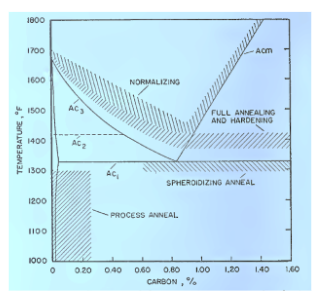
Fig. Recommended Temperature ranges for Heat Treating plain carbon steels
-
Normalizing
- Purpose: Refine grain size and homogenize structure.
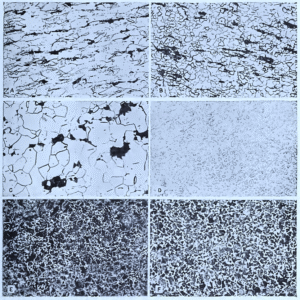
Fig. Representative microstructures of carbon steels.
A, Low carbon steel (0.1% C) as cold-worked. Both ferrite (light) and pearlite (dark) are severely deformed. X100. B, Same as (A) after process annealing at 1,200° F. The ferrite is recrystallized (grains are equi-axed), but pearlite is not affected by this treatment. X100 C, Same as (A) after full annealing at 1,650° F. All traces of cold working are eliminated, and the ferrite grains are larger than in (B). X100. D, High carbon steel (1.1% C) as spheroidized. All the carbon is present in the form of spheroids or slightly elongated particles of cementite in a matrix of ferrite. X500. E, Hypoeutectoid steel (0.5% C) as normalized at 1,600° F in 4-in. round (center area). Because of the rapid rate of air cooling such a small section, the pearlite is quite fine and relatively little free ferrite is formed. X100. F, Same steel as (E) but normalized in 24-in. round (center area). The slower rate of cooling due to the larger section results in coarser pearlite and more free ferrite. X100.- All etched in picral.
-
Hardening (Quenching)
- Purpose: Maximize hardness by forming martensite.
- Heat above the upper critical (Aₑₛ), hold until austenite (γ-iron) forms and dissolves carbon fully.
- Cool very rapidly (water, oil, or brine) so that austenite transforms into martensite (a needle-like, super-hard phase) instead of pearlite or bainite .
- The achievable hardness depends on carbon content (more carbon → higher hardness) and section size (larger sections cool more slowly, so may not fully harden) .
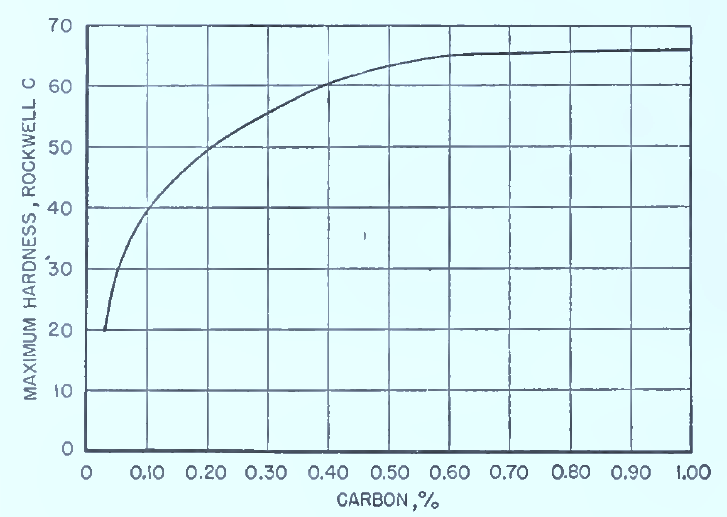 Fig. Relation of maximum attainable hardness of quenched steels to carbon content
-
Tempering
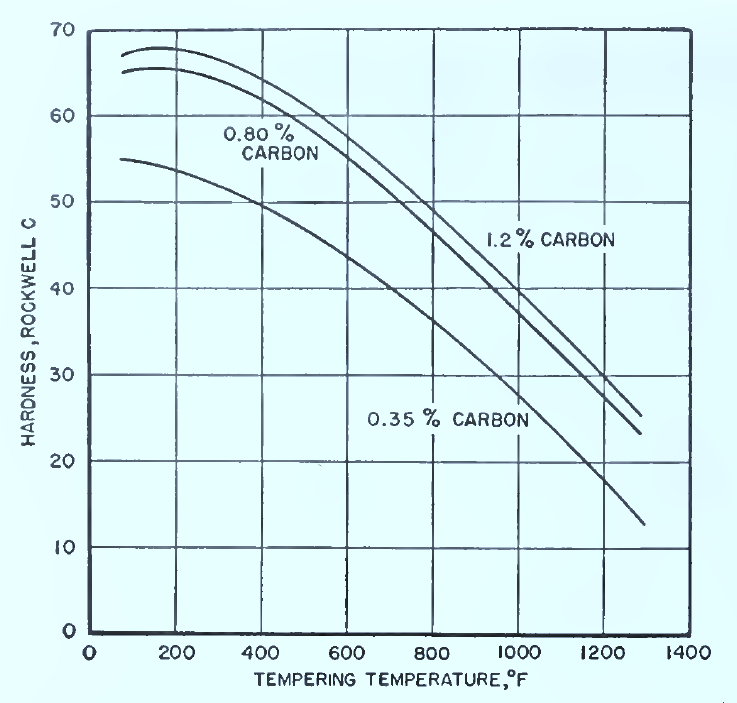
Fig. Effect of tempering temperature on the hardness of carbon steels of different carbon content
-
Case Hardening
- Purpose: Create a hard, wear-resistant surface (“case”) over a tough, ductile core.
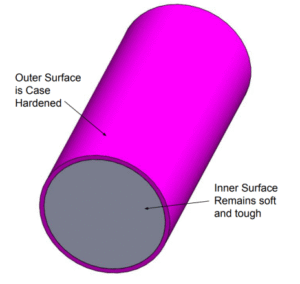
- Carburizing: Heat low-carbon steel in a carbon-rich atmosphere (pack, liquid, or gas) above Aₑcₛ so carbon diffuses into the surface. Typical case depth: 0.030–0.050 in. in 4 hr at 1,700 °F. Quench to harden the case only or both case and core .
- Cyaniding: Immerse steel in molten cyanide salts at 1,550-1,600 °F for 15-120 min. Add both carbon and nitrogen for a thin (≤ 0.020 in.) case, then quench .
- Carbonitriding: Similar to gas carburizing but with ammonia added, fast case build-up to depths like carburizing, quenched in oil .
- Nitriding: Expose steel to ammonia gas (or molten nitriding salts) at 950–1,050 °F for 1–2 days. Forms an extremely hard nitride case (≤ 0.020 in.) without quenching .
-
Surface Hardening
- Purpose: Harden only the surface by rapid, localized heating without altering chemistry.
- Induction hardening: High-frequency induction coil heats just the surface layers above Aₑcₛ in seconds; quench immediately with water jets. Depth controlled by frequency and time .
- Flame hardening: Direct a high-temperature gas flame onto the surface above Aₑcₛ, then spray-quench. Best with 0.40–0.50% C steels
-
Special Treatments
- Austempering: Quench from above Aₑcₛ into a hot bath just above the martensite start (Mₛ) but below the pearlite nose. Isothermal transformation yields bainite (tough and hard). Limited to small sections (≤ ¾ in. for carbon steels) .
- Martempering: Quench to a bath about Mₛ, hold until uniform, then air cool through Mₛ–M_f. Reduces internal stresses and cracking.
- Cold treatment: Quench below room temperature (often to dry-ice or liquid nitrogen) to convert retained austenite to martensite in high-alloy steels.
Practical Notes for Engineers
✓ Use accurate thermocouples to monitor heat. ✓ Always allow enough soaking time (½ hour per inch rule). ✓ Match quenching medium to section size. ✓ Prevent scale formation and decarburization using protective atmospheres. ✓ In mass production, salt baths are useful for uniform rapid heating (up to 2450°F). Heat treatment isn’t just about raising or lowering temperature, it’s a journey through steel’s inner structure. Whether you’re designing a hardened gear, a ductile shaft, or a surgical scalpel, understanding heat treatment lets you manipulate steel’s inner personality. And remember → heat alone doesn’t shape steel. It’s what you do after that truly makes the difference.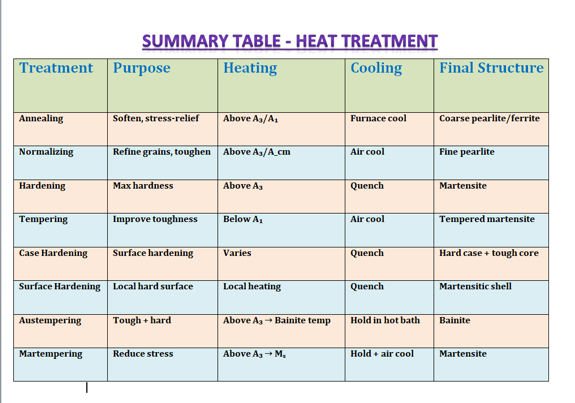
Heat treatment is only proven once it is measured. Hardness and tensile results are recorded as part of our quality and inspection routine, and if you want the method behind the numbers, our guide to Rockwell hardness testing explains how the scales are read.
Written by the Esteem Auto engineering team
Steel is a different discipline from iron and we treat it that way. Esteem Auto casts carbon and alloy steel alongside its iron work at the Metoda GIDC plant in Rajkot, using the same melting and inspection discipline but with the shrinkage allowances, gating and heat treatment that steel actually needs. Running both under one roof means we can say honestly when a part is better made in iron.
Most casting defects are settled inside the plant rather than argued about afterwards. Composition is confirmed on a spectrometer, structure is checked under microscope, hardness on a Micro Vickers, and tensile results are recorded per lot on 400 kN and 1,000 kN universal testing machines. Our IATF 16949:2016, ISO 9001:2015, ISO 14001:2015 and ISO 45001:2018 certificates are published on this site so you can read them rather than take our word for it.
Steel work tends to arrive as a drawing rather than a part number, which suits how we are set up. Send yours to sales@esteemauto.com, or exports@esteemauto.com if you are buying from outside India, and we will tell you whether the grade specified is the one the application calls for.